
Note: Before reading any further, this is where the vile rubber meets the road. I feel strange having to explain myself as a writer, but I am also a member of this global community, so I feel like I owe you a warning and explanation. You are going to find the most offensive racial slur known to all in the section you are about to read. I tried to work around it. In early versions, I used other words – softer words – so as not to offend readers, but I realized two things. You (readers) should be offended. You need to be offended, by the word, by the dehumanizing effect that comes with it. Read it. Hate it. Feel the anger. Feel the weight of it. The second thing I realized is that I discovered I was just giving racists cover by using those “softer” words, I was making racism more palatable. Racism is ugly. It’s brutal. I won’t let racists hide by using softer language.
I was younger by ten years than most in my company. Joined at the start of it all at fourteen. Least wise I think I was fourteen. Could’ve been a year or two or more off in either direction. Daddy didn’t give a shit when I was born. Irked him enough that I was. He didn’t find no reason to commit the occasion to memory. His disdain for me wasn’t no different than the disdain he spent on just about everyone else. He hated my two older brothers just the same. Hell, you wanna know the truth on it, I’d feel more affection for him if’n he hated me more than them. Least that way I’d feel me and him had us something special.
Momma was too damned sad and lonely to remember things having to do with birthing her two demon-boys. My oldest brother, Douglas, he was just a brother by half. She wasn’t around when he was born. His momma was dead and gone ‘fore he was eight. My brother Charles was momma’s first. I was her last. She had a handful ‘fore, between, and around us but they either come out dead or died soon after. Too quick to get named. They was buried all about our little rice farm in unmarked graves.
Army said fourteen was too young to join, so I lied and give my age at eighteen. For all I knew I could’ve been just that. I was tall. Two plus yards high. Made of skin and bones. Still had a baby face, but the Army didn’t give a shit about that. They took my word on it and threw me into Company K.
Everything was so new and unplanned when I joined that me and a random group of miscreants was moved to a little patch of grass on the grounds of The Citadel, and we was told to sit tight until someone come and got us. No one did. It wasn’t ‘til the break of day a full twelve hours later that they remembered us. Regiments had already been formed, and they was too damned tired and lazy to put any more thought into dividing us out, so they stuck us together, give us the unofficial title of Company K, and told us that as soon as they could get around to it, they’d give us a command. We was to read up on our Hardee’s tactics manual and be ready to drill as soon as our peep of chicken guts was assigned to us.
I had a head start on such matters. Being a Miller man and all. We was a militia of boys formed by Cameron Miller. A man so rich God himself went to him for high-interest loans. He and his advance man, Mr. Stockton, give us a run-through on every page of the Hardee’s tactic manual every living day starting two years prior. I’d done the drills so much I dreamed on them.
Mr. Miller trucked it to Columbia the day after the cannon’s fired on Fort Sumter to get himself a rank as high as General either by dollar or fist. He had endless funds and fury, and he was going to spend as much as needed of both to be General Cameron Miller. He vowed to build his regiment around his Miller men. I joined up before he returned for two reasons. I hated the bastard being the first, and I hated him even more being the second.
Captain Docherty come along to direct the company about two-three weeks after they named us. He was as short as I was tall, and he smelled of high-dollar soaps and perfumes. He was plantation swill. Aged in his twenties. Never bent his back a day in his life to earn so much as a fat mistress penny. His daddy bought him his bars. We paid for his inexperience.
We had a rough go of it for the months and years that followed. They shifted us this way and that. We went Savannah way up to Virginia, over to Tennessee, and then Mississip’. Back to Charleston and circled around to Georgia and Chattanooga. We was the most well-traveled bunch of battle-broken soldiers ever to carry a rifle and wear a uniform. Good many of us died. Mostly from shitting ourselves to death. Good sight more soldiers die of diarrhea than bullet. Won’t read about that in your history books. No sir.
A lot of this and that happened ‘fore January 2, 1863, but those are all stories that have been told before. Other soldiers on both sides of the war have talked on it. Most lied about what they done and saw, but a few come out with the horrible truth. I ain’t got it in me to talk about what I did on the battlefield. I’ll just say it was worse than awful, the things I saw, the things done to me, the things I done, the reason all of it was done, and I’ll leave it at that.
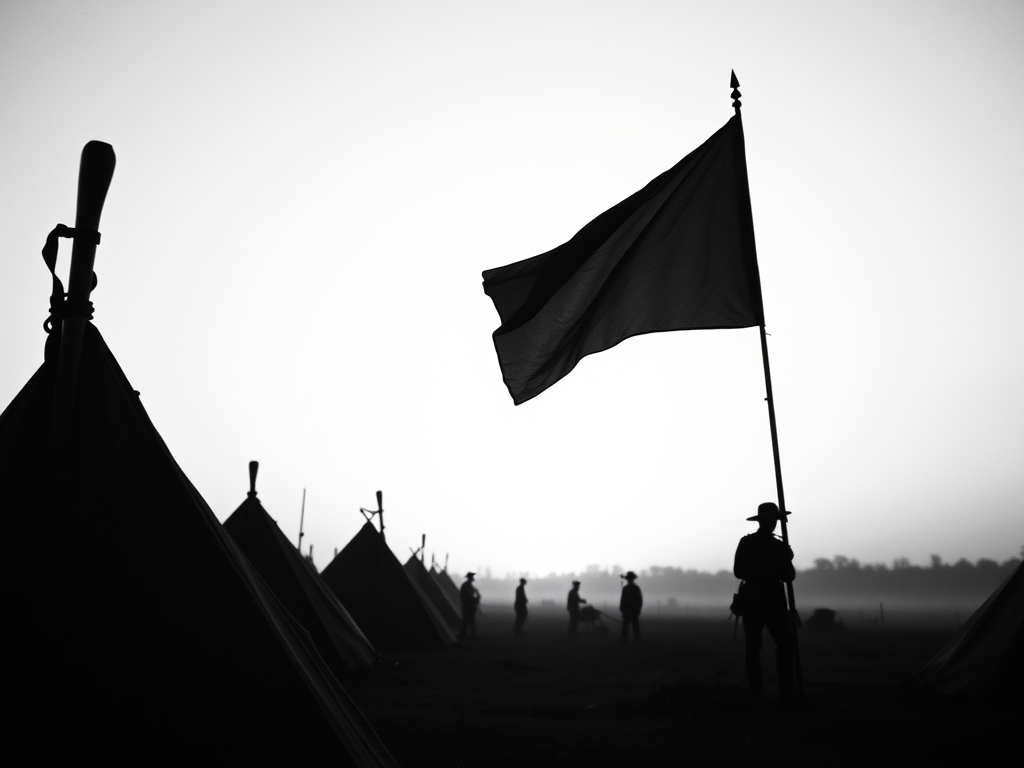
The day our company flew under the black flag ain’t nothing that’s ever been heard. It thumps wild against my skull from the inside out whenever I give it too much thought, and I’ve managed to push it aside for going on five decades, but seeing Otto at Felix’s open grave, struggling to stand without aid of the leg I took from him, it come rushing back to me.
Young as I was, I was still given the rank of corporal. I run the drills them days we had no command. Men three times my age fell in line and didn’t give me no lip while I led them through drill after drill. Captain Doc made me a corporal soon as he learned what I done.
On that second day in January, I was called to his tent at the ass-crack of dawn. I entered wiping crust from my eyes. The little captain sat at a small wooden table that served as his desk for correspondence. The pot-bellied Sargeant Bill Hick stood on his left flank. The captain was in a state of half dress, and it was apparent the sergeant had dressed in a good hurry. He had been summoned out of his sleep to Captain Doc’s tent, same as me.
The captain held up a piece of paper. “News from Richmond.”
Noticing his sour expression, I said, “Not good, I take it.”
“Lincoln – That dog – He’s done it. He’s set them free – As predicted.”
“He freed the niggers,” Bill Hick said, shaking his head as if I was too damn stupid to figure out who the hell Lincoln had freed.
The captain continued. “He made no secret of it. The lanky bastard has been threatening to do it since September. Never thought he’d see it through. His emancipation proclamation adds but a deeper drench of Union blood to this war.”
“He’s made him a miscalculation is what he’s done,” I said. “A mighty one, at that. Kentucky will join us now. Maryland, too. Maybe even parts of Ohio and Indiana. He’s just broke off more territory for the Confederacy. We gained ground without firing a shot.”
The captain shook his head. “He’s too shrewd for such an outcome. He’s granted freedom to only those slaves in the states in rebellion – The Confederacy itself.”
I shrugged. “Then he just shit in his own hat. He ain’t got no authority to grant freedom to Confederate slaves. The Confederacy is outside his say.”
A chuckle from the captain. “Coloreds won’t see it that way. They’ve gone from property to potential threats to our sovereign rights as a free and independent nation literally overnight. When news of their freedom reaches their ears, we will be surrounded by pockets of insurrectionists throughout the entirety of our country. Lincoln has used his pen with more lethality than the whole of the Union army has with their rifles and cannons. The front to this war has just swallowed us.
“Every slave from South Carolina to Texas will turn their savagery on us whenever the opportunity strikes, and the Yankees will clap ‘em on the back for doing so.
“Company leaders were called to assembly before dawn. We’ve been given orders to hold no quarters to any darky that so much as gives looks of sass and defiance. They’re all to be considered insurrectionists unless vouched for by members of good standing in the community. Understood?”
“Word is Jeff Davis himself give the order,” the sergeant said with a misplaced smile.
“The next step for the Yanks is to enlist the coloreds and hand’em weapons.”
“Lawd help us.”
“It’s coming. Sooner rather than later, and it’ll put an extra stir into our slaves. We need to make sure they know that the divine aligns with the Confederacy by putting the fear of God into them.”
“Yes, sir. That’s for sure,” the sergeant said. “We need to dog whip’em sumbitches into being obedient little ol’ pups.”
“No arbitrary action is to be taken,” the captain said in an admonishing tone. “But when punishment is called for, there will be no half-measures. From this moment on, we are fighting under a black flag, gentlemen. No prisoners. No wounded. No mercy. Lincoln has not only put our troops in deeper jeopardy, he has put targets on the backs of our women and children, as well. It is incumbent upon us to tamp down the negro uprising before it starts. Come mid-week, our company will head due west to serve conscription notices to every able-bodied man we can find and inspect every plantation in our path. We need to find rabble rousers before they have a chance to rouse the rabble. Domestic males and drivers must be given special attention. Too many have been taught to read and write to assist them in their duties, and that serves as deadly tread to the Confederacy.”
My mind locked on Tate. I’d know’d him since I was waist high. I may have been the only white who truly knew him. Well, me and Momma. He was leased to a merchant vessel that sailed all over the world when he was a boy. The ship’s captain, Arnault, did not abide by the rule that slaves couldn’t learn to read, mostly because he was bored as shit spending months at sea. He taught Tate to read and write in English, French, and Latin, and just to add another thorn to the rose, he give him lessons on high-level arithmetic. Shakespeare, Hugo, Plato, Watt – Five years at sea give Tate a heavy head full of more knowledge than any man I knew or heard of. And he was smart enough to give the impression he knew none of it. He hid his know-how from everybody but me and momma. He allowed himself to trust us because I suppose everyone’s got to have people they trust in their lives, otherwise it ain’t worth finding your next breath. Neither me nor momma have faculty for guile. He seen that the day he showed up on our farm all those years ago. He come to us on loan from Mr. Miller. I liked him right off. Momma, too. She was a schoolteacher ‘fore she got saddled to daddy. Try as hard as he could to hide it, she seen the learning in Tate.
Last I’d heard, he was Mr. Miller’s footman. He was only safe from the flap of the black flag because he was heeled to the Devil. His misfortune was his good luck. I was happy and sad for him all at once.
I wasn’t enlightened. Let me relieve you of that notion right off. I was cooked in the stew of the South same as everyone else. Blacks, they was inferior to whites. You expect me to believe different as a soldier in the army in service to the Confederate States of America, your expectations are a whole entire universe off target and there ain’t a word that exists to call out how dumb you are. I was brought up to think they was too savage to be free and too feeble-minded to be assimilated into society. I’d come to think different over the years as I watched fella after fella with my pigment and a mastery for bigotry burn the world to ash. But as a teenager standing in Captain Doc’s tent, learning of our orders to hold no quarter toward black men who showed an aptitude towards reading and writing, I was a lifetime away from that sort of thinking. I was a dutiful soldier, and I feared that given the circumstance of fulfilling that duty by applying it to Tate, I would do so. I prayed for his safety. From me.
By mid-week, Company K broke camp. We headed West as ordered with a trunk full of conscription papers. I’d gone on one other conscription run before, and we ended up bringing back six men. Two required medical attention because they was quarrelsome cusses that needed convincing with fists and rifle butts to fulfill their compulsory military service.
The laws since the first Conscription Act our company enforced had changed. Rich shits could now hire substitutes to fulfill their service, and any plantation owner with twenty slaves got themselves out of serving. The twenty negroes act thinned our ranks in a good many regiments in a short bit of time when it passed the Confederate congress. Men of means who joined the army with a whoop and a snarl before the battles commenced jumped ship and hid from the fight they’d started about a minute and a half after the law was passed. The draw of soldiering was no match for the call of luxury beckoning for them once again. They sat their fat-asses back on their verandas, sipped on sherry, and invented stories of their honored service.
A half day into our travel and we come upon a small tobacco farm that had found hard times. The barn and slaves’ quarters was run down by rot and a wake of turmoil that comes from a war waged on near every side of your property line. The main house had its chips and dents, too, and it could use some paint and minor cobbling. It was well-lived in, but by the looks of it, the folks inside were not well.
I was a good deal taller than the others in our company, so I was made a member of the greeting party, along with the captain, and his aide, Lieutenant Liddle. He was a bit on the irksome side, but otherwise tolerable. I was to be silent. I was for the eyeballs. My height tended to help civilians entertain calm demeanors, even when introduced to unpleasant news. They’d been instructed since toddler-age to hold the government with distrust. Didn’t matter we represented a government fighting invaders on their behalf. We was government anyway you sliced us up, and they weren’t wrong about us in this case. We come to take from them.
A woman of advanced age answered our knock on the door. Her hair was an unkempt blonde heap that rested in a bundle with a lean to the right on the crown of her head. Her face sported wrinkles and rosacea. The dress she wore was an irregular blue, as fading had crept its way along the sleeves and torso. Her name was Elvira Jeffries, and she weren’t a kind woman. Whether she was or not before the war, ain’t clear. All that was known to me is that she spoke with nail and fire.
“You’re too late,” she said, following a groan of disgust. “We’ve already been robbed by the boys before you.”
“Boys?” the captain asked.
“Confeds – Our glorious fighting force – They come through a month ago and took our pigs and my house girl. We’ve not meat for the table, and Clara was the best seamstress I had. We’re left but squirrel for dinner and garments that suffer from lack of repair.”
Captain Doc removed his hat. “I’m sorry you were troubled by some of our soldiers, ma’am. I hope they followed protocol and left you a promissory note for your pigs and girl.”
“They left nothing but trampled ground. What is it you wish to steal from me?”
“Nothing – We are not here for provisions. We are simply here to document ownership of this farm and the current number of occupants it holds – free and slave. We’ve only come to take a census and leave.”
She scowled. “Owned by my husband. Derrick Crawford Jeffries. Six of us reside here. The slaves should be 20, but as I said our house girl was took. The current count ain’t accurate.”
“And that current count would be nineteen?”
“If you want to put a fine point on it. Nineteen is where we currently stand, yes. They’s all just about useless to me. Most sit idle without my husband’s hand here to guide them, but they are occupants nonetheless.”
“The six – They are adults?”
“Three of us.”
“All women?”
“The adults – yes.”
“And the children?”
“Two boys and a girl.”
“Ages?”
She hesitated. “They’re children – Grandbabies. I don’t recollect their exact ages.”
“Approximate ages will do.”
“Margaret – She’d be around eight or so. Felix – I put him at about sixteen.”
“And the third child – The other boy?”
“Not sure.”
“As I said, approximate age will suffice.”
“I can’t even put in a guess.”
“Older or younger than Felix?”
“Why are you not writing this down?”
“Ma’am?”
“You said this is a census of some sort. It seems something like that should be put down on paper.”
“My aide, Mr. Liddle, he is committing this all to memory. We will record the information when we put up camp for the night. Older or younger, Mrs. Jeffries – The second boy – Older or younger than Felix?”
She dithered before saying. “Older, but not by much.”
“Physical impairments?”
“You’re short, but I wouldn’t say that’s an impairment.”
“No – Not me, Mrs. Jeffries. The oldest boy, does he have any physical impairments?”
“He wears spectacles.”
“No shame in that. I wear them to read myself.”
“Yes, well, Otto must wear them all his waking hours.”
“Your husband, is he home, ma’am?”
“As I did not include him in my numbers, I’d think the answer to that is an obvious no. He’s on travels.”
“Travels?”
“Business.”
“He does not hold military service?”
She chuckled. “He’s an old man. Older than me by fifteen years, and I am old. Your army does not want him.”
“And your grandchildren, where are their parents?”
“Their mother – My daughter-in-law, she lives with us.”
“Your son – Her husband?”
“Dead.”
“My condolences. Was he lost in the war?”
“He was, but not a thing lost these days comes without attachment to the war.”
“May I ask in which campaign he was lost?”
“You may, but it would not be a relevant question. He did not die in a campaign.”
“Then how did he -”
“Malaria. Died just three weeks after he signed up. We were told he was infected in transit to his assigned regiment.”
“I am both deeply sorry for your loss and grateful for your boy’s service -”
“Service? He served nothing. He lay in soiled bedding for the entirety of his so-called service. In what way does such a state of misery earn your gratitude?”
“That he would commit such sacrifice to serve his country,” the captain said, sounding defensive and bemused by her offended tone. “I will always be grateful for his intention to take up arms for the Confederacy.”
“Then you waste your gratitude – Do you not have enough information for your census?”
“Who manages your coloreds?”
“Jonathan – Our driver.”
“And he was included in your servant headcount?”
“Of course – I grow tired of these questions -”
“This Jonathan – Can he read and write, ma’am?”
She hesitated. “He has but a simple creature’s grasp of his letters – It’s required for his duties. He’s to log the events of the workday – That’s it. His entries are indecipherable to anyone who is not used to his – manner.”
“But he can read?”
“Poorly.”
“Are there any others, ma’am?”
“Other what?”
“Slaves who can read and write.”
“No.”
“Thank you, Mrs. Jeffries. Your cooperation will be noted in our report.”
“That’s it then?”
“For the census. I will require to speak with the oldest boy.”
“For what purpose?”
“It is a military matter, ma’am, and if you could enlist someone in the household to take Lieutenant Liddle to pay Jonathan a visit, that would be very much appreciated, as well.”
“Again, I must ask for what purpose?”
“And again, I can only say it is a military matter.”
“I do not serve in the military, Captain Docherty.”
“No, ma’am, but the soil on which you live is under the protection of the army in which I serve, and I have a duty to do so by whatever means I deem necessary.”
“So, it is the dirt you fight for, is it, Captain?”
“It is your rights, left to lay fallow in the dirt by invaders, for which I fight, Mrs. Jeffries. They would have your farm recede in production and profit from the hardship of a dwindling workforce. Their own Supreme Court says negroes are – by fate of birth – destined to toil in perpetual servitude. It is the only thing for which they are suited. It is a matter of natural law – It is God’s law, and I am in league with the government that is committed to enforce His law. Your uncooperative turn puts you in violation of that law, which puts you in league with the government that intends with force under bullet and bayonet to eradicate God’s law. Respectfully, that is not a position you want to take, for I would – under an abundance of caution – be inclined to assume your family entire shares the same sense of treason, and it will become another situation in which I will have to address by whatever extreme measures I deem fit. Is that understood, Mrs. Jeffries?”
She pursed her lips together and narrowed her gaze before stepping back into the doorframe and shouting for Felix. A boy appeared almost immediately. He was gangly and held the appearance of a pampered lad who had taken a hard turn. He and I were most likely the same age, but my appearance outpaced him by at least ten years.
He was ordered to take Liddle to the fields so he could interview Jonathan.
“I will bring Otto to the porch,” Mrs. Jeffries said, as Felix rushed down the steps and trotted in the direction of the fields with the lieutenant following at a brisk pace.
“Yes, ma’am,” Captain Doc said, adding, “I’ve close to a hundred men in my company. They have a most ruinous reaction towards acts of aggression by those outside of our ranks.”
She smiled timidly as she recognized the thinly veiled threat.
There was a moment of silence before Captain Doc said to me without looking in my direction, “Be prepared, Corporal. I am of the opinion the boy’s enlistment will be met with fierce opposition.”
Yes, sir.”
“Remember, the rules have changed.”
“Sir?”
“We hold no quarter.”
I was confused. “Yes, sir, but I thought that was – Slaves and the like, sir. Those that take up arms -”
“Not just slaves and not just those who take up arms. Any who resist in the execution of military action are to be treated as insurrectionists, Mr. Tennyson. They are to be -”
A gunshot from inside the house put the captain and me on deadly alert. He pulled his sidearm, and I readied my rifle. We entered the house single file with our heads on swivels. The sounds of a woman wailing and a male howling in pain raced down the corridor just past a set of stairs, and we quick-stepped toward it.
Reaching a door, the captain slowly pushed it open and revealed two women standing over a boy sat flat-ass on the floor in the kitchen. The smell of gunpowder filled the room, and a rifle held by Mrs. Jeffries choked out smoke from the barrel. The boy was retching from pain, and his right foot was near severed at the ankle by a fresh gunshot wound.
“What in God’s name?” The captain said.
Mrs. Jeffries was visibly shaken, but she held her tone. “You may discuss your military matter with Otto, captain.”
Captain Doc took a moment to gather his wits. “Corporal, give the boy aid.”
“Yes, sir,” I said as I rushed to the boy and knelt beside him. I hollered to the sobbing woman, “A towel or kitchen cloth, ma’am. Do you have any handy?”
The boy’s eyes fluttered as he approached lights out.
The woman was well-anchored to anguish, and she couldn’t bring herself to move, much less fetch me a towel.
I stood and surveyed the area, and then recoiled and spasmed at the sound of a second gunshot. The report in the somewhat small space disoriented the fire out or me. I wheeled around and brought my rifle at the ready when I saw Mrs. Jeffries lying on the floor with a hole in her face from her left eye to the top of her skull. Blood burped out in waves.
Captain Doc was pained in the face something awful as he watched the last glint of life leave the woman’s body. “Hold no quarter,” he whispered to himself. He turned to me. “The boy, Corporal. The wound. Tend to it.” In what can only be described as a hellish calm, he turned his attention to the sobbing woman. “You are the mother – Of the boys?”
She was bunched up. Shook to her core. She didn’t hear the question, or if she did, her brain couldn’t direct her mouth to speak.
I knelt again and examined Otto’s wound.
“Ma’am, I must insist you collect yourself,” the captain growled.
She looked at him, drawing in sputtered, sniveling breaths.
“Are you the mother of Felix and Otto?”
The wounded boy finally lost full consciousness and slumped forward.
The woman screamed.
Captain Docherty knelt beside her, grabbed her by the shoulders and shook violently. “I must insist you stop this blubbering. It does no good.”
“She is Kendra Jeffries,” a woman said from the doorway to the corridor. She was older than the crying woman, but far younger than Mrs. Jeffries. She was broad and stout and sported a thick mane of inky black hair. “You just murdered her mother.” The woman didn’t have no shake in her voice nor frame. She was calm as a church on Monday AM.
Captain Docherty stood. “You are?”
“I am Michelle Jeffries – Margret, Felix and Otto’s mother. Widow of Private Winston Jeffries.” She took a step across the threshold, and Captain Doc pointed his sidearm at her.
“I do not invite your approach.”
“I do not care,” she said without breaking her stride, stopping when she reached her wounded son. She knelt, ripped the left sleeve from her dress, and wrapped Otto’s wound. I watched in awe as she did this all with a chilling grace. She was a hard woman, and it felt necessary and wrong all at once.
The captain holstered his weapon. “I did not murder Mrs. Jeffries. She wounded a Confederate recruit. As such, she provided aid and comfort to the Union. She is but a Yankee casualty.”
“She is a victim of your cruelty, sir. You may lie to yourself, if you wish, but murder cannot be undone by your semantics.”
“And her crippling your boy? What of that? His foot is lost. What of her cruelty?”
“She saved him from dying far from here in the stifling staleness of this mad war.”
Captain Doc sighed and then struck a wild, malicious smile. “Her actions merely transferred the burden and honor of service to your other boy.”
Michelle Jeffries shook her head. “He is not of age. I know the law, sir –”
“Mr. Tennyson, how old are you?”
I looked at him, puzzled.
“Your true age, corporal. Not the age you gave to enlist.”
“Sixteen, sir. Maybe. Could be older. Could be younger. I ain’t got a lock on my birth date. The year, I mean.”
Michelle Jeffries laughed. “You are no more sixteen than I am sixteen.”
I shrugged. “It’s my best guess. It’s most likely the truth of it.”
“I don’t believe you -”
“His appearance belies reality, ma’am. Some boys look old for their age. Some look young. I am under the impression – And as a representative of the Confederacy, that means the military entire is under the impression that Felix looks as old as we need him to be.”
She stood and struck a sternness that no starred general could have managed to strike. “Then shoot me now, Captain, because I will fight you with teeth and claws to prevent you from taking either of my boys. This war is not ours. It is yours, and you can have it, but you cannot have my boys.”
“With solemnity, I will shoot you, ma’am, because that is my duty if you resist, and I will then have to decide which fate to hand down to the rest in your family. My company is not equipped nor inclined to take prisoners, and that will weigh heavily in my decision making.”
“You are a barbarian, sir.”
“I am a servant to the military code under which I am commissioned to uphold. I do not find pleasure in the actions I am required to take, but my commitment to my orders is the marrow that nourishes the bones of my service. I will kill every member of your family, and it will be hailed as a Good Slaughter by those in my command. I will receive pats on the back while you and your children are interned for eternity into the grounds of this farm, and this homestead will become publicly held property under the control of the Confederate States of America. Your death will profit me with praise and your country with land to feed its treasury. Tell me, what incentive do I have to violate my duty, ma’am? Sentiment? A mawkish concern for your life over the whole of my country? I do not possess such concern. I cannot afford to. Yes, I am a barbarian. You are correct. But wars are not won with civility. Present your teeth and claws as promised, and doom all in this household to execution.”
Her sternness melted away. She swallowed the sorrow that nipped at her spirit. “Take Felix, but if he does not come back to me when this war is done, I will find you, Captain, and I will take a blade to your neck, and my God will reward me with adoration, sir, for you are but a demon who He awaits to vanquish to hell.”
“And that is how much I love my country, Mrs. Jeffries. I submit myself to his wrath for violating his Commandments in order to save this nation that he loves so. If hell is where he wants me, it is where I will dutifully maintain my post for all of time.”
“Damn your duty, sir. Steal my son and be gone and take with you a mother’s curse. From this moment forward, my condemnation will haunt you all the hours you have left in this world. Misfortune will find you at every turn.”
“It is a fool’s curse, ma’am, for my misfortunes now likely belong to your son, as well.” He turned his attention to me. “Carry the lad upstairs, Corporal. Give care to his injury. Leave laudanum with Mrs. Jeffries.”
“What care shall he give? I do not desire nor want any charity from you, Captain.”
“It is not charity, nor is it for you. It is my duty to see to the wellbeing of a recruit felled by the enemy.”
“He was felled by you, sir. His grandmother was protecting him from you and your war.”
“Your sense of perversion saddens me, ma’am. You would be wise to let Corporal Tennyson look after him. He’s spent hours upon hours as a wounded and unwell soldier with scores of Confederate surgeons. He’s even assisted in procedures that have saved the lives of dozens of our gravely wounded warriors.”
She looked at me. “You make the claim that he is both a boy-soldier and a capable physician. I do not believe either.”
I spoke softly. “My age don’t hold measure with my experiences, ma’am. The captain’s right. I’ve been patched up more than a pair of farmer’s trousers, and fevers have sent me to convalesce with a medical unit a half dozen times or more. The army does not let even its wounded spend idle time. They put me to work assisting with operations and caring for those sicker than me more times than I can count. I can help your boy.”
She hesitated before nodding.
I quickly picked up Otto.
Mrs. Jeffries steered me to a door to the right. “Clara’s room. It is unoccupied.”
Following her, I entered the room and gently laid Otto on the bed. Sweat drenched his unresponsive face. I stood straight and thought long and hard before turning to his mother to say, “A saw.”
She looked at me with horror and anger. “What?”
“It is early, ma’am. If we act quick, he’ll lose nothing but the foot. If more time passes, the infection will take hold, and he may lose the leg entire, and that will take a surgeon with skills that few possess.”
“This is how you help?”
I nodded.
“He is to be a cripple?”
“He’s to live. I seen this kind of wound kill dozens, ma’am. The infection is a demon. It will bring fever, such fever that delirium will keep your boy awake, feeling hunted by a league of invisible imps. Fear and pain’ll stay with him for days. No amount a laudanum will give him peace. Then a calm’ll come. He’ll take on a stillness and appear to be on the mend, but it ain’t nothing but the infection gathering up a demon horde for its last deadly charge. In no more time than it takes to blink, he will insist that he’s been set ablaze, that his skin is falling off in pieces, blowing away like ash in the breeze. Agony. Well, ma’am it’ll be the only thing keeping him alive.
“He’ll be left with nothing but a pounding pain if I remove his foot. It’ll be bothersome, and he’ll truck towards madness from it, but he’ll live.”
Her cheeks flush, and her lips went pale. “We’ve a butcher’s saw in the kitchen.”
“That’ll do.”
She turned to exit, but I stopped her.
“I’ll need the captain’s assistance.”
“No. He is not to touch my son.”
“But I need him to hold your boy down.”
“Otto is out. Unconscious.”
“He won’t remain so once I get to cutting.”
She couldn’t conceal her repulsion. “I shall hold him.”
“Ma’am – Yes, ma’am, but I will need more than you. The pain, it ain’t a bee sting. Your boy’ll thrash about like a fish on a hook. I seen it drive one poor soul to such feats of strength that he tossed a nurse right out a window with little more than a flick of his wrist.”
“I love my boy, but he is not capable of such strength under any amount of distress.”
“When the teeth of the saw begins to grind away at his bone, he ain’t gonna be in distress. He’s gonna be in hell.”
“There is Samuel. He will assist.”
“Does he possess a strong constitution?”
“Most assuredly. More than your captain, I wager. He’s witnessed much more horror in his life than any man should be expected to take, not the least of which being men of your military stealing away with his wife.”
She exited the room, and I rummaged through my haversack to retrieve my bottle of laudanum. It was both friend and fiend – the most valuable item I carried with me – an elixir that I’d been given after a Minie ball grazed my hip and took with it a fragment of bone. It soothed the pain, but more importantly, it fogged the mind. With laudanum in my belly, I was transported from the torment of war and placed into an observatory – a theatre where the brutal strokes of battle played out as if staged for my viewing pleasure. The chaos become a ballet, and the death throes that surrounded me were nothing but mere curtain calls. The time between campaigns was a series of intermissions where the audience found refreshments and the players discovered energy to perform the final act.
It was a goddamn ball and chain that followed me around, and I traded out food rations for it with my fellow rebs. When I had been sent to identify the bodies of the fallen at the conclusion of skirmishes and battles, I would check the dead for bottles of laudanum before I would seek out any correspondence on the poor fools that was meant to be sent on to their loved ones or paper tags with their names. Who they were didn’t mean a thing to me. Their possession of the poppy-seed elixir meant everything.
I examined the bottle for what seemed like an eternity and an hour before I took a swig and placed it back in my haversack. It would not go to the wounded boy. I could not part with it. I told myself he would profit more mightily from the suffering caused by saw to bone than he would from the dull escape from reality the bottle would provide. He’d be chased hereafter from one agonizing memory to the next, and I couldn’t have that. That chase belonged to me, and I did not want others to follow, not out of a sense of concern for my fellow soldier, but out of a sense of selfishness. The hollow journey of need owed to the fiendish tonic was a dark comfort that I did not want to share. It was a devilish love affair that I wanted all to myself. That there is also the power of laudanum. It tricks you into believing there ain’t enough of it to go around. It’s plentiful. There’s enough to replace all the stars in the sky. The war give rise to an ocean-load of the stuff, but a fella affixed to it holds the belief that it is as scarce as a four-leaf clover. Parting with even a drop of it would be an act only for the foolish.
Mrs. Jeffries returned with the butcher’s saw in hand and a black man of considerable size in tow. He was as broad at the belly as he was at the shoulders, and one could see even covered by trousers that his legs were as thick as tree trunks. His expression was dour, and I could only assume signaled his harsh feelings for the presence of Johnny Rebs on the property.
I could not help but feel relieved by his stout structure. “I hope this is Samuel,” I said.
“It is,” Mrs. Jeffries said, handing me the saw. “Of course.”
“Do you have whiskey of any kind?”
“We do not practice temperance on this estate, Mr. Tennyson. We’ve liquor of all varieties.”
“Well, we’ll need gallons of it.”
She exited the room at a brisk pace.
“Samuel, you will hold him at the thigh. Grip with all your might. Put your weight into it. He can’t be allowed to so much as twitch that there leg. Understood?”
“Yes, sir.”
I removed my knife from its sheath and cut a length of cloth from the top bedsheet. I then grabbed the cloth at both ends and twirled it into a tubular shape. “I am not skilled at this,” I said to myself more than I was explaining to Samuel. “I’ve served same as you, holding the poor fella down. Done it more times than I care to count, and I’ve made waste of the amputated limb. Thrown it out like a bad cut of meat. Left to be ‘et up by dogs and raccoons. But truth to you, I ain’t never done the actual cutting.”
“His foot’s nearly off,” Samuel said. “The skill needed don’t appear to matter much. A cut and a yank should do it fine.”
“It’s not that simple. That would leave jagged bone beyond skin and muscle. I need to make an even cut above the wound, so it will heal proper. That means I’ll have to cut through the shin bone. Ain’t a thing about that gonna be pleasant for him, for me, even for you. This would be easier if the wound was at the knee.”
“So, cut it off at the knee, sir. He’ll be just as crippled if you cut four inches down as he will be with a stump at the knee. It’s six in one hand. Half a dozen in the other.”
I shook my head. “I ain’t got skill enough for that. I’ll kill him dead sure as shit.”
“Seems to me he’s got more ways to die than to live at this point. Any direction you choose will likely be wrong.”
I placed the twisted cloth underneath the leg a few inches above the wound. “You ain’t much on giving a fella confidence, are you, Samuel?”
“I was called in here to hold Master Otto down. I ain’t got no confidence to give. You’ll have to come up with that your own self.”
“Then do what you were called fer. Hold him down. One hand at the thigh. One at the shoulder. We’re about to get a rise out of him.”
Samuel did as commanded, and I waited until I saw the skin tone in his knuckles drop a shade or two in color before I brought both ends of the tourniquet up, intertwined them and pulled at the ends as if I were setting a snare. Otto come to with a blood-curdling scream, but Samuel’s strength was hardy enough to keep him from moving his leg. I pulled ever harder on the ends of the tourniquet until the wound offered up but a trickle of blood.
Mrs. Jeffries bolted into the room, holding a bottle of whisky. “Has it begun? What are you doing?”
“Momma!” Otto yelled upon hearing her voice. “Help me! Please!”
She stopped dead in her tracks and, for the first time, sported a look of fear. Her free hand covered her mouth as she sought to stifle a cry.
“The whisky, ma’am,” I said. “Pour it down his gullet.”
She did not move.
“Now, ma’am. We ain’t got time to burn.”
She snapped to and quick as a flea stepped to her son’s side. “How do I administer it?”
“His mouth, ma’am. Open. Pour. Ain’t much more to it than that.”
“But he does not have a taste for it.”
“Pour and then clamp his mouth shut. He’ll drink or drown.”
She looked at me as if I’d just called on her to torture her own son.
“Samuel, it’s on you. Mrs. Jeffries will pour the whisky down Otto’s throat, and you will place your hand over his mouth. He’ll swallow. He won’t have no choice.”
“Yes, sir.”
“Pour, Mrs. Jeffries. Pour. The liquor won’t soak his mind right off, so we need to get as much in him as we can as quick as we can.” My sense of urgency was not just for the boy. It was for my own self, too. I had worked up my nerve enough to begin the sawing, but I didn’t know how long I could sustain it.
Mrs. Jeffries closed her eyes for a tick of time and then put the opening of the bottle just above the boy’s mouth. The brown liquid flowed into the gap between his lips and Otto squirmed, managing to spit some of it out before Samuel clamped his hand over the boy’s mouth.
Mrs. Jeffries pulled the bottle away and stepped back, placing her free hand on her forehead as the stress of the moment nearly cost her consciousness.
“None of that, ma’am. Stay with us, Mrs. Jeffries, or I’ll have to call on the captain to take your place.”
She wiped snot from her nose. “I am fine, Mr. Tennyson. I am capable of caring for my boy.”
Otto squirmed and fought to remove Samuel’s hand, but it was like a baby tugging at an anchor. His throat relaxed, and I knew he’d swallowed.
“More.”
Mrs. Jeffries and Samuel repeated the process.
When I saw that he had swallowed again, I called for them to do it again and again and again, until the bottle was empty.
The fight in Otto went soft, and his panic was nothing more than confused panting. I called on Samuel to clamp down on his thigh harder. “Mrs. Jeffries, lay across his chest. Give him all your weight.”
“Can we not pause? He’s not yet given into the full effect of the whisky.”
“We have to act now before he pukes it out of his system.” Him throwing it all up wasn’t what concerned me in the least. I was losing my nerve, and I couldn’t afford to wait any longer.
I was about to take the knife to his skin above his injury but pulled back with a start. “I’ve forgotten something.”
“What?” Mrs. Jeffries asked.
“I don’t – I can’t recall, but I have forgotten a step.”
“Then this cannot be done. Let us leave it -”
I looked at Otto’s pale face, and it hit me. “A bit.”
“A bit?”
“Something to bite down on, or else he’ll swallow his tongue or bite it clean off.”
I frantically rifled through my haversack and found an unspoiled copy of a pocket Bible. Captain Docherty, a religious fiend of sorts, had gifted it to me after he’d overheard one of my many rants against the church and God and such in camp some months prior. I took it from him with a smile and never cracked it open. I didn’t have the heart to tell him that I’d read the book entire before my tenth birthday, on Momma’s command. It wasn’t the only book she’d made me read. I’d read a library full of books under her watch. It was the teacher in her. She threw the Bible in there because she knew that those who preach on it lead men around who’d never read a word of it and had no idea the lies and truths it held. I don’t know if I believe in God or not, but I do know the Book on him don’t resemble the God I want to believe in. Not even the least little bit.
“Here,” I said, handing it to Mrs. Jeffries. “Stick this in his mouth and hold to it. He’ll clamp down on it soon enough.”
She took it from me with some hesitation. “But this is a Bible.”
“And it will finally be of some use. Now, Mrs. Jeffries.”
Without another word, she resumed her position across her son’s chest and stuck the spine of the Bible in his mouth.
I was more than a fair bit disappointed that both she and Samuel had complied so willingly to my instructions. There weren’t a single obstacle left to stall the amputation. I breathed deeply and exhaled in a roar as I sliced his skin around the circumference of his leg just below the calf. Otto twitched all but his injured leg. I’d rested my knee on his uninjured leg to prevent it from obstructing my pseudo-surgery. His muffled screams beat a path around the leather binding of the Bible.
The incision complete, I used the ill-suited and dulling knife to hack away at the muscle. His screams grew more forceful, and he near bucked his mother from his chest.
Sweat poured from my forehead and face into the wound as I worked for what felt like forever and an hour at cutting away the meat. Once completed, I could only allow myself a small sigh of relief before I picked up the saw, placed the metal teeth on the exposed bone and rapidly pushed and pulled the instrument back and forth, giving no mind to the grotesque groan and gurgle of agony that Otto sputtered out. Soon enough, he went still and give way to a temporary oblivion. I cut and cut and cut, cringing at the sound of metal grinding away the wet bone. My back teeth rattled as all I could hear was the unholy grating – the filing of a valley through bone and marrow.
And then, with one final snap, the amputation was complete. I can’t say how much time passed. I can only say that in whatever time it took, none of us in that room was the same. Otto lost his foot, and the rest of us, we lost our ignorance of such terrors. It weren’t my first amputation, but it was the first time I’d had the saw in my hand. Ain’t no way to unwind the feel and sound of it.
As for Samuel and Mrs. Jeffries, they held the boy down while hell was brought on him. They participated in his torture. A healing torture, but torture, nonetheless. Once you’ve done the Devil’s bidding, you can’t shake the feeling you got evil in you.
I opened my haversack with my blood-soaked hands and pulled from it my bundle of paper cartridges and tossed it on the bed. Trembling, I pulled at the twine, but my fingers would not cooperate. “Mrs. Jeffries, I can’t – Would you untie this – I need – Help, ma’am.”
Her hands were shaking, too, but not near as much as mine. Removing the string, she pulled back the thick wrapping, revealing ten paper cartridges. “What do you mean to do with these?”
“The bleeding – I’ve no way to stop it and the tourniquet can’t remain while the wound heals up. I do not know – I have seen this used on smaller wounds in the field, and it done the trick.”
“What do you mean? What is ‘this?’”
“Gunpowder. I’ll spread it atop the wound there and put a match to it.”
“Are you mad?”
“Yes, ma’am. Madder than a loon, but that don’t play a part here. It’ll singe the vessels shut and bring the bleeding to a stop. It should anyway.”
“Should?”
“Like I said, I’ve seen it work on smaller wounds.”
“No – I won’t – I will not allow -”
“I remove the tourniquet, ma’am, his blood’ll likely drain all the way dry. If it remains, what’s below will rot, and kill him cemetery dead.”
“Suture it – Sew the wound shut.”
“Ain’t much on sewing – Ain’t a seamstress around good enough to sew that up. Nor surgeon for that matter. This is the only way.”
“You want to set my boy on fire?”
“It is a flash of flame and sparks that lasts a blink or two.”
“I refuse – It will kill him -”
“Let him, missus,” Samuel said.
She looked at him, appearing stunned that he had sided against her.
“The boy ain’t got odds in his favor either way. Better he go in a flash than trot along in a long trek of misery.”
She shifted her gaze from Samuel to me and didn’t chirp a word for several seconds. There was nothing to be said to upend his argument. She looked away from us and nodded.
“Elevate the leg,” I said to Samuel before tearing the first cartridge open with my teeth. He did as I asked, and Otto stirred but did not wake.
Spitting the paper out, I then spread the gunpowder across the wound. I used a total of four cartridges, dropping each bullet on the floor as I went along.
Pulling my match safe from my haversack, I said, “This will give him a jolt. He’ll need to be pinned down again.”
I sat across his uninjured leg and pulled a box of Whale matches from the tin housing. Samuel suspended Otto’s injured leg in the air and held him down at the shoulder. Mrs. Jeffries grabbed hold of the other shoulder and arm.
I struck the match and set the flame to the driest of the gunpowder on the wound and a great burst of a white firestorm extended from the stump in a twirling percussion, smelling of sulfur and burnt flesh. A puff of smoke followed, and we watched it race to the ceiling as if it were the last haze of infection vacating the injury.
Otto didn’t stir. Not in the tiniest. He’d bared too much pain, and his body wouldn’t let him endure any more suffering. When he would wake in the hours or days to come, he’d become intimate as hell with pain, and he’d long for relief in whatever form it showed itself, but for now, his unconsciousness was a gift. If he was lucky, it would turn from temporary to permanent, so he’d never have to know another minute of this frazzled world that cost him his foot.
I stood, my legs shaky and unsteady. “You may remove the tourniquet. Don’t dress the wound right off. Give it some air. Wait ‘til evening hits then dress it – clean linens only. Change them daily. Do not let the scab set into the cloth.”
“And what of laudanum? Your captain said you would procure us a supply.”
I shook my head. “You don’t want the aid of that tonic, ma’am. Trust me. It is a wolf in sheep’s clothing. Willow bark tea will serve him better in the long run. Whisky in moderation is even advisable. He will have rough days, but they will pass.”
I moved away from the bed and used up a good bit of wherewithal to put footsteps together. It felt as though I’d tumble heels over ass at any second. Without thought of direction, I found myself standing just inside the kitchen soon enough. The matriarch of the family was still on the floor in a lifeless, folded heap, and for the first time, I felt the weight of the rifle that hung from my shoulder. I had lost track of it during the rush of anxiety that overcame me during the amputation. By instinct, I had retrieved it after the foot had been removed, but I couldn’t recall doing so. It’d become a part of my dress, as essential as my britches and boots. I felt naked and foolish without it.
I was overcome by a gut tugging urge to move the corpse – To drag her from the kitchen to the back property – To find a resting place for her – To commit her to the earth below and give feed to the worms and larvae that would give feed to the birds and small woodland creatures that would give feed to the landscape and bigger creatures still. My redemption for my part in this monstrous deed was in the act of burying the old woman and giving life to the saintly brew of the cycle of nature. Never did it occur to me that the most honorable thing to do was lay down my weapon and abandon the war I hated with my whole heart. This day – These acts – They’d split me open and uncovered my true and grotesque character. I was the war.
As if reading my mind, Samuel said from behind me, “Leave her be.”
Without taking my eyes off her, I answered, “It’s too late for that.”
“Yes, sir, it is, but she ain’t your worry now.”
I couldn’t force myself to take another step. “You’ve heard the news?”
“News comes every day, sir. I most likely have, but I don’t know which it is you ask about –”
“Lincoln says you’re free.”
“That – Yes, sir. Heard it.”
“And?”
“Saying a thing don’t make a thing true.”
“Your people – They’re in jeopardy.”
“Jeopardy?”
“Danger.”
“Then ain’t a thing changed.”
“It’s grown worse.”
“How so?”
“You’re to be treated with suspicion – As if you are the enemy. Embedded within our borders. With an eye towards an uprising.”
“And what comes with this here suspicion, sir?”
“Mistrust. You’ll be under careful watch. Every whisper your people share with one another will be questioned. You’ll be regarded as guilty of all manner of sedition. No benefit of the doubt will be spent on y’all. You’ll be blamed for every manner of misfortune that befalls this farm – This country. You are to live entirely under the thumb by those who own you.
“Those that can’t afford their own negroes will grow to resent you. They will level all their woes onto you, the slave.”
“Like I said, ain’t a thing changed.”
I cleared my throat. A call to duty struck me, and I had no desire to answer it. But I did. Much to my shame. “Samuel, do you read?”
“Nah-sir.”
“Can you – Do you possess the ability?”
“Nah-sir.”
“Do you have desire to run or take up arms against your country?”
He did not answer.
I turned to face him. “I asked you a question, Samuel.”
“Ye-sir, you did. I heard you.”
“Then why didn’t you answer?”
“I don’t know how to, sir.”
I gripped the strap attached to my gun. “I suggest you provide me with an answer – At once.”
“I have no plans to leave this property, sir. Your men – The ones who took my Clara – They are to return here with my wife. They said it, sir, before they marched off with her. They said she was to be of service to their General. His uniform and sundries needed darning. He was in want of her skills, sir. I put faith in God that they will hold true to their word and bring her back to me. So, no sir, I have no desire to run.”
“And your country, will you take up arms against the Confederacy?”
Again, he did not respond.
“I require an answer, Samuel.”
“Sir,” he said with some hesitation. “The Confederacy is not my country. The Union neither. I ain’t got a country.”
“Explain.”
“I ain’t got investment in pride for neither. Ain’t got shame in neither. How can I claim or be claimed by countries that give me no reason to revel or recoil at things done for me when not a thing is done for me?”
“You don’t think this war is on your behalf?”
He almost chuckled before managing to stop himself with some effort. “I think this war ain’t nothing but what’s got from a lie. A lie told by men. Masters. Your masters. Not mine. You folks, you built up these men to be spotless. Spit shined and divine. They put to paper this notion. All men is equal. What they didn’t do is give note on what a man is. Didn’t have to. They was men. And all who cast the same reflection? They was men, too. My reflection? It’s of no matter. The Indian? No matter. The orientals. The Mexicans. The dirt-faced aliens on the run from empty pockets and ill bones. We’re all of no matter.
“Thing is no matter, it’s a sickness. Goes from one poor kept soul to the next. Soon enough, you white folks’ll come under it’s burden. More and more of you’ll give into it. You’re of no matter. You ain’t got treasure enough to matter. You run to your masters and you says, where’s my matter? They says back to you, we ain’t got it. Niggers got it. Or that old redskin, he got holt of it. Bandidos, the Black Irish. They all got it. And there’s a whole herd of white folks up north given all your matter to all shades of non-whites. You want it back? You get it from them.
“So, you got yourself a war from a lie because I tell you true, I ain’t got your matter. None of my folks do. And what’s more truer still is you ain’t white enough to matter to the divine men who made themselves equal and no one else. So, here I am without choice but to wait for my wife to be returned to me. All I got is the faith I’ve invested in my God. He is my country, sir, and I would be a fool to take up arms against him. He is my matter – ”
We were both startled by the sounds of screaming from outside. I unshouldered my weapon and give Samuel instruction to pull back the door. Fresh-footed, I made my way down the small stoop and heard a jumble of cries on the South side of the property. Rounding the corner of the house, we seen a gathering of slaves beneath a towering, crooked oak. Hung from its fattest limb by the neck was the twitching body of a black man. A small number of men from my company stood between the dying slave and his bonded family, holding them back with bayonets.
I stood silent and shaken. I knew it was the driver. I knew he’d been found guilty of nothing more than possessing a rudimentary ability to read and write. Lieutenant Liddle had found the slave’s diary, and it was not as Mrs. Jeffries had said. It was decipherable. It was coherent. It didn’t contain no mentions of sympathies for the North, or a desire for freedom, but the man was too competent a scribe to let live. He was deemed seditious by virtue of his ability to commit words and moments to paper. I knew all this because had I been sent to interview Jonathan, I would have passed the same sentence upon him, and that was the great undoing of my soul. I didn’t feel sorrow for the man dangling from a short rope. I felt crazed.
I heard a terrible gurgle and whimper to my left. Turning to it, I saw Samuel fall to his knees. He struggled to command a single stroke of breath. He was struck inconsolable, and a raging wash of tears covered his cheeks.
“Your country has failed you, Samuel.” I don’t know why I said it. The words just come out. I was the war entire.
He looked up at me but didn’t offer no response.
“This here is the value of faith – Agony.”
I could feel his heart breaking, and it angered me.
“You wait for your wife to be returned, but you know she ain’t coming back – She’s gone, boy. She’s being ravaged by the men who took her – That she could sew weren’t of no consequence to them. She’s stripped clean of clothing and spirit by now. Her faith? It was in you, and you weren’t up to the task of fulfilling her belief in you. You know that we ain’t the last to come through here. There’ll be more – Confed and Union – Soldiers of all commitments and ranks will march through this property, and they’ll leave you with less and less each time. Your faith will be tested – Your country – It’ll be trampled upon. You’re but a trifling pissant to your God – Your country ain’t got no love for you.
“You know all this. You must. And yet you except all of it – The cruelty – You’re weak, and I hate the fire out of you for it – I hate your turn of the cheek. This I vow, I will carry out my duty with speed and joy. Faith won’t earn you freedom. Faith won’t win this war. Men with bayonets and bullets will win this war, and I’ll march forth with fury to bring hell upon my enemy – You, Samuel – You are that enemy because you ain’t got it in you to fight, and I hold no quarter. I am duty bound not to.”
He looked up at me with bloodshot eyes. “I’ve done nothing -”
“And that is what offends me. You do nothing. You accept your lot. You volunteer your wrists for the shackles -”
“Because it is not just me who be shackled, sir. My children – My brothers, sisters – All who share sweat, tears, and toil – We are fixed to one another – If I stand up and fight, you will beat me down, and all those in my kinship. I will gladly give you my blood, but I will not march them to the lash because I could not hold my anger.”
“Samuel, you hold your anger to your end.”
“And you, sir – You embrace your anger to yours.”
I left him planted in grief and marched to the hanging man. The wails and screams of the slaves shuddered my heart. When I could take no more, I raised my rifle and took aim at the dying man at the end of the rope and pulled the trigger. The bullet entered his chest. Dead center. The specter of life vacated his body at once. His toes spread and pointed upward in the abruptness of his passing.
Lieutenant Liddle furiously pushed his way through the crowd and stepped to me with a sneer. “Corporal, the captain was clear in his orders. I was to make a spectacle of the insurrectionist’s death – For the show – To leave an indelible mark upon the others – Any act of sedition will be met with capital punishment – In the most extreme -”
“Sir, look at these people. Do you not think they got the message?”
“Yes – Well – We were also told not to waste ammunition on coloreds in rebellion unless necessary.”
“I am of the mind, lieutenant, that wretchedness of this kind only adds starch to their spines.”
“Do not undermine my rank, Mr. Tennyson. I have been given charge –”
“The seditionist is dead, Mr. Liddle. Your charge has been fulfilled.”
Captain Doc approached on horseback. “The boys on the run. Gather this lot, lieutenant. Search the woods beyond the barn. Make haste.”
“Yes, sir.”
“Corporal, you make a poor representation of our company.”
“Sir?”
“The blood, Mr. Tennyson. There is a well to the east. Make use of it. Scrub yourself presentable.”
“Yes, sir.”
“I trust the procedure went well.”
“As well as can be expected, captain.”
“Fine. Mr. Liddle, why do you not gather these men as I have instructed?”
“Yes, sir. Right away, sir. It’s just that there is a matter of insubordination – By Mr. Tennyson, sir.”
“Immediate action is of the essence, lieutenant. I will hold hours for any and all disciplinary actions at a time that is less exigent.”
“Yes, sir,” Liddle said as he gave me one last look of derision before directing the men to gather at the edge of the woods.
“Do I need to concern myself with his complaint?” the captain asked as the lieutenant and the troops quick stepped it towards the barn.
“No, sir. Nigger’s of no matter. Dead. Like you ordered. Ain’t a thing I did that made him any less dead.”
“Noted. Wash up. Find order in your appearance. The iron fist of leadership is better received when it gleams from spit and varnish.” He turned his mount to ride away but stopped when I called for him.
“Sir, this is Confederate territory, ain’t it?”
“What’s your point, corporal?”
“Shouldn’t we take spit and varnish to it? So that it’s better received. So that the things we done here – our actions are better received?”
“Out with it – What are you asking, Mr. Tennyson?”
“A woman lies dead in the kitchen and – The seditionist, he swings from this here tree -”
“And they are now of no use to our enemies -”
“Yes, sir – Of course, sir, but they should be buried. Laid to rest. Proper.”
“Proper? Why should we take such honorary measures for traitors?”
“Because this here’s our country. We should seed it with what you call decorum, shouldn’t we. Otherwise, we make enemies of the others. – Ain’t it wise to offer them up a show of peace – of piety? ‘Bless them that curse you and pray for them which hurt you.’”
The captain considered my position, and answered, “I am happy to see the Bible I gifted you has driven you to virtuous desires, Mr. Tennyson. Organize the coloreds. Use their labors to dig the graves. Let’s not pass up the opportunity to remind them the place they hold under God’s providence. You are in charge of offering forgiveness to our enemies and giving them passage to our great heavenly Father.”
As he rode away, I fought the need to wretch. The scripture I’d quoted set a flood of bile up the back of my throat. I took to suckling at my bottle of laudanum the second the captain was out of sight. My mind set in a haze, I oversaw the construction of the two graves, allowing the youngest of the Jeffries’s clan to pick the location of the plots. To my surprise, she picked an area beneath the shade of the hangman’s oak where both bodies would be laid to rest, side-by-side. The young girl did not speak otherwise. She crawled into a space of mournful retrospection.
I found the well to the east and washed away the blood I had drawn from the boy and then returned to the now completed gravesites. The driver was already resting at the bottom of his, while Samuel emerged from the house carrying the elder Mrs. Jeffries, followed by her daughter and granddaughter.
An unnatural, unsettling silence consumed the property entire. Birds and insects give no indication of their presence. The wind give no howl and did not tickle the leaves of the trees. I didn’t hear any around me let out a heavy breath or even so much as a sniffle of grief. The absence of sound give rise to a feeling of rot. A dark drop of blindness hung heavy over the crowd. Even in all the horrors I’d lived, anger, sorrow, fear found voice in the chaos and moments to follow. But not here. Not in this place. Not in this hour. This was a terrible silence that set me to feeling pointless and futile – We – All of creation – We are nothing but servants to time. What we do, how we live, who we hurt, who we love – None of it means a damn. Our lives are illusions, and we’re all but mere peons placed on the Earth to give entertainment to the spirit of time. Our lives are slaves to the almighty tick of the clock, and not a one of us is free from its selfish and impulsive nature. Samuel was wrong. There is no matter to be had. In all the world. For any.
These were the thoughts that washed through my mind as Samuel climbed into the grave and gently laid Mrs. Jeffries to rest. Finding his way out, he turned to me – Everyone turned to me. They stared, and I saw pity in their eyes. I had brought them destruction, and they showed me pity rather than hate.
I cleared my throat. “I ain’t the right person for this – I don’t have religious ways – God ain’t – Hell, I don’t know what he is. How the hell am I gonna tell you what he ain’t. My momma says God is curiosity. She has peculiar thoughts on things.” I scanned the faces looking back at me. “You wanna know what’s got me curious. Why ain’t God chose a side in this mess? He’s gotta know what’s right. I mean that’s pretty much his thing. Yet, we’re out here killing each other. Yanks and us. We’re shooting at one another. Stabbing one another. Hell, I pushed some poor fella’s face into a slop of red clay until he give out. Must’ve died with a pound of mud in his lungs.
“And y’all, I don’t get you folks at all. It’s clear as glass God ain’t made no decision on you neither. You better off slave or free? He ain’t got no answer on that situation. And yet y’all, you search out for forgiveness and comfort from a God who don’t care a whit if you’re suffering or thriving. If your slaves and it ain’t meant for you to be, then why you offering up prayers to the fella. Hell, He should be asking for your forgiveness. I don’t understand none of it. Don’t a damn thing about the world entire make sense to me.
“That’s about it. That’s all I got to say on the matter. You can bury your people and give your respects, but I got no interest in carrying on.”
The wind finally let out a howl at the end of my glorious citation of woe. My uninspiring words claimed no victims. They were still believers, and their pity for me grew even stronger. I felt a spark of shame for challenging their faith in a time when they most needed it, but I also felt a towering anger that they clung to their faith for no good goddamn reason. If God was real, I was sure as sugar that he needed their love more than he was willing to show them his, and I could give a damn if he loved me.
I vacated the gravesite and walked towards the barn where Liddle had organized a search party for the boy. They had an hour head start on me, and I weren’t given instruction to follow after, but I couldn’t remain on the farm no longer. I’d done so much wrong within its borders that I felt as if the ground would try to swallow me up at any moment and deliver me to the Devil himself.
Now the Devil, he’d most likely find me bothersome because I do his business better than he does it. He’d most likely do me in for fear I’d take his job. I was capable of great and horrible things without him having a hand in any of it.
It was a sneeze that give the boy away. Beneath the rickety flooring of the barn was a pair of eyes staring up at me. Felix had found entrance to the space between the floor and ground, and he planted himself amongst the spiders and mice, waiting for Company K to give up our search for him and move on to the next farm. His plan was but one more hour from success.
“Come on out, Felix,” I said, peering down at him where he lay between my boots.
He didn’t answer.
“There’s no use pretending we ain’t staring at one another.”
“I don’t want to join the war. I can’t be made to. I am only sixteen.”
“I most likely am, too.”
He hesitated before saying, “That’s a lie.”
“It ain’t.”
“You – It just can’t be.”
“I am tall for my years.”
“Your height is the least of what ages you. Your face has seen a lot of years.”
“I’ve lived a hard life. If you don’t come out, I will extract my rifle from my shoulder, push the barrel through this here space between the floorboards, place it to your forehead there and shoot.”
“Why?”
“What?”
“Why would you shoot me?”
“Because you’re what’s known in military speak as a fugitive. Your military service is what’s called compulsory. By law, I ain’t only within my rights to shoot you. I am duty bound to do so.”
“But I am – Momma said I am not of compulsory age.”
“My captain has determined otherwise.”
“He’s wrong.”
“According to military code, I ain’t got authority to determine his command of the facts. What he claims is factual is enough for me.”
“Why?”
“Because there’s rules, and I have agreed to follow’em. If’n I don’t, some other fella dressed in a uniform similar to mine will shoot you dead. When you’re inducted, you’ll get handed the same rules on following rules. There’s a whole mess of ways to get shot in this army.”
“I won’t join.”
“Then you’ll get shot. Like I said.”
“By you?”
“If I’m ordered to.”
“Why?”
“This inquisitive nature of yours ain’t as endearing as you might think.”
“I just don’t understand.”
“Wars ain’t to be understood by folks like you and me. We’re here to shoot at bluebellies and to get shot at by bluebellies. Politicians and rich folks do all the understanding.”
“Can I be with you?”
“What?”
“Can I serve with you? Can I be in your company?”
“Why in the blaze of hell would you want to serve with me? I’ve threatened to shoot you.”
“I don’t get the sense that you mean it, and we are the same age.”
“Your senses are off, and I got no idea if we’s the same age or not.”
“Close enough”
“We’re both whatever age the captain says we are ‘cause the army needs us to be that age.”
Felix considered my point. “I suppose there’s nothing to be done about it then”
I smiled. “You’ll make a fine soldier, Mr. Jeffries.”
His fingers appeared through the cracks, and he pushed on the floorboards. I stepped away and a small section of flooring give rise, and he tossed it aside. Pushing himself up on his elbows, his head popped up through the now open portal.
“Can I?”
“Can you what?”
“Serve in your company – With you?”
“That is not a choice I get to make.”
“But you can request it, can’t you?”
He struggled to pull himself from the hole in the floor, so I reached down and extended a hand. “Requests can be made, yes, but I ain’t one whose requests are given special consideration.”
He grabbed my hand, and I yanked him up. “Your captain likes you.”
“What makes you say a fool thing like that?”
“The way he talks to you – Talks about you -”
“Yeah, well, you’ll come to learn that officer talk is cheap.”
“But it wouldn’t hurt – To make a request.”
“It might hurt. It might not. Requests – small or big – Can sometimes lead to a world of hurt. That is how the army works.”
He looked tired and worried.
I folded my arms and stared down at him. “What would be our position?”
“For what?”
“For my request – To have you serve in our company – With me?”
He smiled. “Say that you promised my mother. Say that she begged you to look after me. Say that she is owed that much.” He sat upon a crate full of sundries.
“All mothers of soldiers are owed that much.”
“Yes, well, they say my brother is shot. They say the captain took his foot. He’s gotta owe her for a thing like that.”
“More mothers than I can count are in like positions. And I’m the one who cut your brother’s foot off.”
He stared at me with a look of disbelief and horror.
“Couldn’t be helped – He would’ve sure enough died in a week’s time if he was left with it. Your sweet-old granny shot him at the ankle. Don’t know if that was her aim, but it was where the bullet struck, and there weren’t no healing to be had with that mangled old paw of his. Amputation was called for, and I was called on to cut it free because I got the most experience in such things. But I’m here to tell you, most ain’t much.”
“You took his foot?”
“I did. Your mother helped. Samuel, too.”
“Was it – What was it like – to – Remove it?”
“Ain’t as fun as it sounds.”
“I have slaughtered a pig and butchered it. On my own. Without any aid.”
“Then next foot or dangling body part that needs removing falls on you. I’ll gladly turn that sort of thing over to you.” I instructed him to stand. “I’ll put in the request. For you to join our company. I’ll offer to train you up. I got a knack for that sort of thing anyhow.”
A small grin found purchase on his face as he followed me from the barn to the northern pasture, where Captain Doc had set up a table to view a map and plot out our next stop. “Do I get a uniform?”
“Official uniforms are a scarcity these days. Will scrounge something together.”
And just like that, Felix Jeffries was the newest member of Company K. There were procedures for new inductees that weren’t followed. They was meant to be processed by officials who documented their names, hometowns and kin, and then they stuck the tail wags in regiments made up of other men from their town, county, or state. Cohesion, they called it. But procedure don’t hold up far into a war. When holes need to be corked, you plug it up quick as you can with whatever you got. For better or worse, he was mine to train up and look after. Can’t say I was up to the task. I’d run steward over another, and he ain’t here to tell you what a fine job I done keeping him alive, but that’s a story for another time, if I can ever find the spine and river of whisky to tell it.

 Horrible Harvest
Leave a comment